
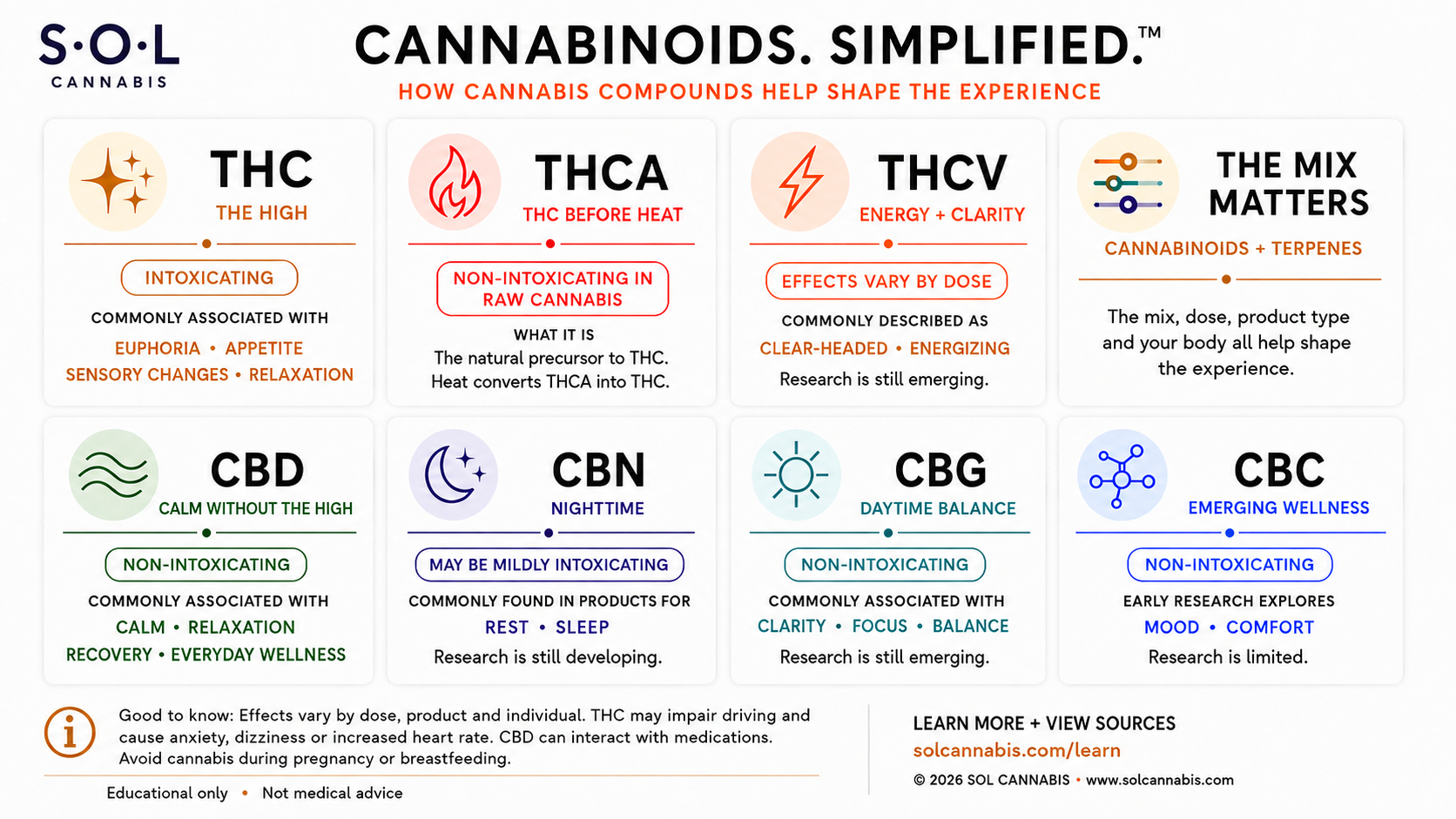
Cannabinoids are compounds found in the cannabis plant and in the human body. The cannabis plant produces many cannabinoids, but THC and CBD are the best known. A product label can report measured amounts; it cannot, by itself, tell you exactly how a product will affect you or establish that the product treats a health condition.
Start with the label, not the legend
Cannabinoid names often become shorthand for effects: THC means "strong," CBD means "calming," CBN means "sleep," or THCV means "appetite." Those shortcuts are often more confident than the evidence. The responsible approach is to identify what was measured, in what unit, in what product, and then distinguish established facts from early or conflicting research.
The major cannabinoids you will see
| Compound | What it is | What a label can tell you | What it cannot promise |
|---|---|---|---|
| THC | The primary intoxicating cannabinoid in many cannabis products. | A measured amount or concentration, depending on product and label format. | A precise intensity, mood, medical result or safe-driving time. |
| THCA | An acidic precursor commonly present in unheated flower and some concentrates. | Its measured concentration and contribution to total-THC calculations used by a label or COA. | That the product is non-intoxicating after heating or use. |
| CBD | A cannabinoid that does not produce the same intoxication as THC. | The measured amount or ratio in the tested product. | That it is risk-free, non-interacting, sedating or effective for a condition. |
| CBDA | The acidic precursor related to CBD. | Its measured concentration when included in the test panel. | A clinically established benefit in a retail product. |
| Minor cannabinoids | A broad group that may include CBG, CBC, CBN, THCV and others. | Whether a laboratory reported a measurable amount. | A reliable feeling or therapeutic benefit based on the name alone. |
THC and intoxication
THC can affect attention, memory, coordination, judgment, perception and heart rate, and it can produce unwanted effects such as anxiety, panic or confusion. Risk varies with amount, potency, route, frequency, age, prior experience, other substances and individual factors.
Higher is not automatically better
A larger THC number does not establish product quality or personal suitability. For someone with low tolerance or uncertain response, higher potency can increase the consequences of a measurement or timing mistake.
CBD is not a universal safety shield
CBD does not create the same intoxication as THC, but that does not make every CBD-containing product harmless. CBD can interact with medications, product quality may vary outside regulated channels, and research involving a purified prescription CBD drug cannot be transferred to ordinary retail products.
Some high-dose human research has found that orally consumed CBD can alter THC metabolism and increase or prolong some THC effects under specific conditions. This is another reason not to assume that a ratio has one predictable meaning for every route and amount.
Acidic cannabinoids and heat
Cannabis flower often contains more THCA than THC before heating. Heat can convert THCA into THC. Labels may use formulas to estimate "total THC" or show several cannabinoid values. Learn exactly which value the package is presenting before comparing two products.
Quantitative rule
Every potency example must show the unit, the source field, the formula, the assumption and the rounding. The public website should not calculate a personal dose.
Minor cannabinoids: an active research area
These cannabinoids appear in smaller amounts in most cannabis products. Their names are increasingly visible on labels and menus. The marketing language around them often exceeds the evidence.
CBG
A minor cannabinoid studied in laboratory, animal and limited human contexts. General consumer benefits are not clinically established.
CBN
Often marketed for sleep, but broad sleep claims exceed current evidence for ordinary dispensary products.
CBC
A minor cannabinoid with early research; product-level claims require much stronger human evidence.
THCV
Often marketed around energy or appetite, but the name on a package does not substantiate those outcomes.
Prescription cannabinoid drugs are not the same as dispensary products
The U.S. Food and Drug Administration has approved certain prescription drugs that contain purified or synthetic cannabinoids for specific indications. That approval applies to the exact drug, dose, formulation, manufacturing controls and studied use. It does not mean the cannabis plant or every THC- or CBD-containing dispensary product is FDA-approved medicine.
How to read cannabinoid evidence
Identify the actual intervention
Was the study about smoked flower, vaporized flower, an oral extract, a purified cannabinoid, a prescription drug or a synthetic compound?
Match the route and dose
A swallowed high-dose formulation cannot be assumed to behave like inhaled flower or a low-dose beverage.
Identify the population and outcome
Who was studied, for how long, and what exact outcome was measured?
Review the whole evidence body
One small study, animal experiment or laboratory mechanism is not enough to prove a consumer benefit.
Include harms and uncertainty
A truthful explanation covers side effects, interactions, study limitations and conflicting results.
What a cannabinoid ratio can and cannot do
A THC:CBD ratio can help compare the measured composition of products. It may be useful when a consumer is intentionally seeking less THC or a product containing both compounds. It does not prescribe an amount, guarantee that CBD will cancel THC, or establish a medical outcome.
Questions to ask when comparing cannabinoids
- Is this value a percentage, milligrams per serving or milligrams per package?
- Is the number on the package consistent with the batch-specific COA?
- Is the product intended to be inhaled, swallowed, used under the tongue or applied?
- How many labeled servings are in the package?
- What is known about interactions with my prescriptions or medical conditions? Ask a clinician or pharmacist, not a retail guide.
- Is a marketing claim based on the tested product, or is it borrowed from a different formulation or early study?
Maryland claim standard
A therapeutic or medical claim in cannabis advertising requires competent and reliable scientific evidence and the required risk information. Headings, icons, metadata, product links and overall page impression all contribute to the claim.
Explore at SOL Cannabis
Next Step
What Are Terpenes? →Learn how aromatic compounds shape scent and flavor, why batches vary, and what terpene information does and does not establish.
Reviewed by: SOL Education Team.
Sources
- [Government source]Maryland Cannabis Administration — Medical and Therapeutic Claims Standards
- [Government source]National Center for Complementary and Integrative Health — Cannabis (Marijuana) and Cannabinoids: What You Need to Know (2023)
- [Government source]U.S. Food and Drug Administration — Cannabis and Cannabis-Derived Products, Including CBD
- [Government source]National Institute on Drug Abuse — Cannabis (Marijuana) Research (2024)
- [Government source]Centers for Disease Control and Prevention — About Cannabis
- [Government source]National Academies of Sciences, Engineering, and Medicine — The Health Effects of Cannabis and Cannabinoids (2017)
- [Government source]Federal Trade Commission — Health Products Compliance Guidance
Continue Learning
Cannabis 101
What Is Cannabis?
The plant, its history, its compounds, and why modern cannabis is not the cannabis of previous generations.
6 min read
Cannabinoids & Terpenes
We ❤ Terpenes
What terpenes are, why they matter, and a guide to the five most common ones found at SOL.
7 min read
Product Formats
Cannabis Flower
What flower is, how to read a potency label, package types, aroma, and what to know before you buy.
9 min read